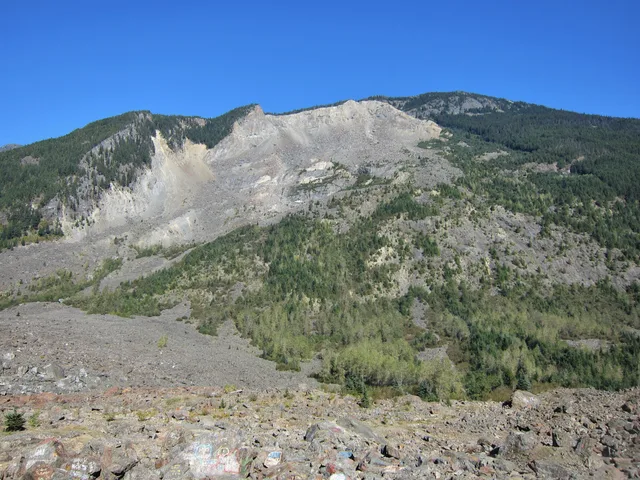
On 9 January 1965, near Hope in British Columbia, a huge mass of rock broke away from the slopes of Johnson Peak. Geological Survey of Canada research estimates the displaced volume at about forty-eight million cubic metres. A vast debris field remains where the base of the slope once stood.
Previous aerial photographs already showed deformations. Analysis of the seismic records suggests two large avalanches separated by about three hours. The first movement would have removed support from the upper part, favoring the second. Researchers do not find a clearly identifiable seismic or meteorological trigger for these events.
Contrast between slow preparation and sudden breakage. A slope can deform for a long time before exceeding a stability threshold. This does not make it possible to read in a simple photograph the date of his fall: the geological study reveals a progressive history, while the disaster appears brutal on a human scale.
What we know
The succession in two movements is the interpretation proposed by the researchers; no certain triggering earthquake is invented.
To go to the source
References accessed October 11, 2026. Linked pages may be in another language.
Signaler une erreur ou apporter une précision