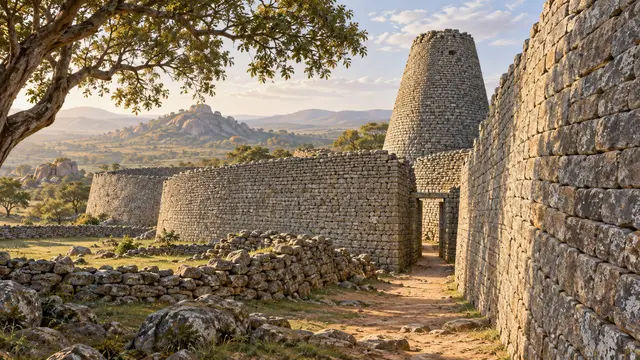
The walls of Greater Zimbabwe impress with their mass and the regularity of their assizes. Their particularity appears by looking at the joints: the dry stone masonry assembles the blocks without mortar. The monumental effect is based on the choice and arrangement of the stones, rather than on a binder between them.
In the Great Enclosure, cut granite blocks draw curves, narrow passages and a high conical tower. These constructions belong to a group developed by the Shona populations during the Middle Ages. The site also preserves traces of dwellings using other materials: the whole city was not only made of stone.
The objects found by archaeologists illuminate a commercial, agricultural and artisanal society. The legends that attribute these buildings to a biblical origin do not replace this research. The most amazing detail is enough on its own: without cement between the blocks, the builders gave the stone a lasting monumental organization.
What we know
Shona construction attested; biblical accounts distinguished from the facts.
To go to the source
References consulted on September 21, 2026. Linked pages may be in another language.
Signaler une erreur ou apporter une précision