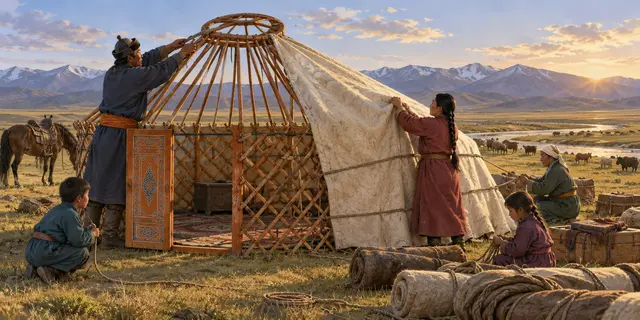
Does a house have to stay in the same place to be a real home? The Mongolian ger, often called yurt in French, offers another answer. Its structure can be dismantled, transported and then reassembled. This mobility is not a temporary defect: it is part of the very design of the dwelling.
The wooden frame supports a blanket of felt and canvas, held by ropes. The elements must combine lightness, flexibility and resistance. Their manufacture brings together different know-how: wood preparation, sewing, painting and wool work. Assembly and disassembly mobilize the family, and children learn by observing the elders.
The installed object is also a series of gestures to know. Preserving a ger in a museum is not enough to preserve its entire heritage. An essential part travels with the people able to do it again. Here, the continuity of the home is not only based on the permanence of its address.
What we know
Not all Mongolians live as nomads.
To go to the source
References consulted on 3 October 2026. Linked pages may be in another language.
Signaler une erreur ou apporter une précision