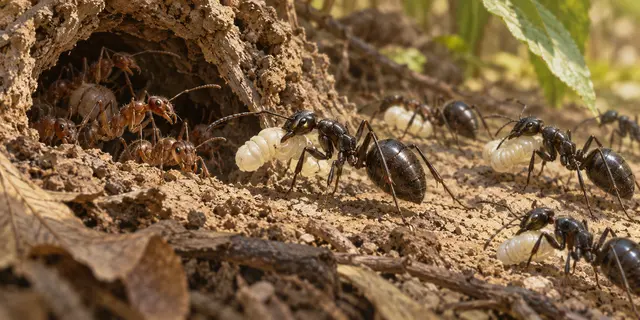
A colony of ants can lose much more than reserves during an attack. In some parasitic species, raids target brood: the young are carried away and then grow in the nest of the attackers. Having become workers, these ants participate in the functioning of a colony that is not that of their origin.
A study published in 2009 on Protomognathus americanus, however, describes a limit to this exploitation. Workers of the host species destroy part of the brood of the parasitic ant. Researchers interpret this behavior in the context of adaptations and counter-adaptations between species.
The expressions “slavery” and “rebellion,” common in these works, are metaphors of behavioral biology. They do not presuppose human institutions or a political project in insects. Natural history is no less hectic: the nest that seemed to benefit from the work of captured young can harbor behaviors that reduce its own reproduction.
What we know
Social parasitism and brood destruction observed; human vocabulary used only as a scientific metaphor.
To go to the source
References consulted on September 21, 2026. Linked pages may be in another language.
Signaler une erreur ou apporter une précision