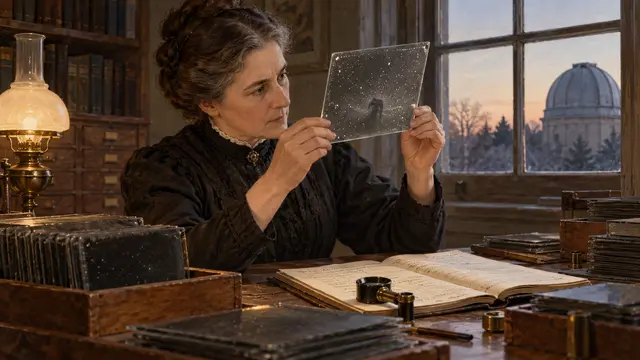
Colorful images of nebulae can make us forget the modesty of the first clues. In 1888, Williamina Fleming noticed on a photographic plate a small singular area, far from the spectacle of modern images. It identifies what will become famous as the Horsehead Nebula.
The work at Harvard Observatory isn’t just about looking in a telescope. Glass photographs become documents to be examined, compared and annotated. Fleming also studies variable stars: his notebooks retain positions, measurements of brightness and approximations with reference stars, on images taken at different times.
It discards plates that are too weak or poorly developed and notes these choices. The discovery is therefore not just a lucky look on a spot. It belongs to a patient practice where the quality of the clues is examined. A photograph of the sky may contain an as-yet-unknown object; someone must learn to distinguish it.
What we know
The discovery is based on the examination of a plaque, not a colored vision in the eyepiece.
To go to the source
- Harvard Plate Stacks — Variable Stars and Nebula (new tab)↗
- Harvard Plate Stacks — Citation Guide, plaque B02312 (new tab)↗
References consulted on September 21, 2026. Linked pages may be in another language.
Signaler une erreur ou apporter une précision