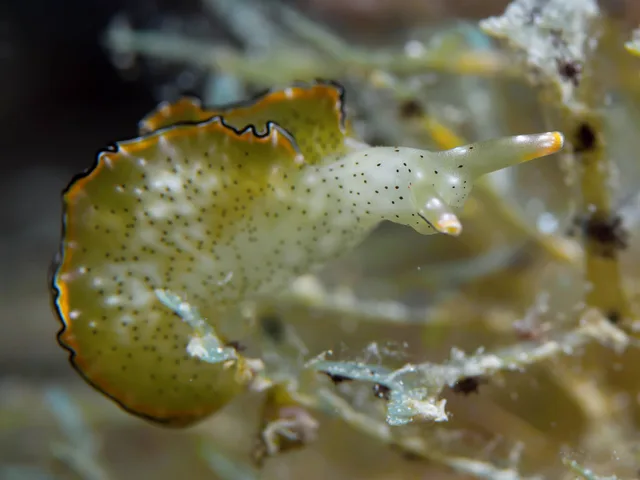
A slug’s head continues to move as it has lost the rest of its body. The scene could be taken for a trick. It was however followed in the laboratory by Sayaka Mitoh and Yoichi Yusa, who published their observations in 2021.
In the animals concerned, separation occurs at the neck. The detached head can move and resume a diet based on algae. In young individuals, a new body is then formed in several weeks. It is therefore not just a small wound closed: major structures of the animal are rebuilt after the separation.
However, the limits of observation must be maintained. Not all heads succeed in this regeneration, especially in older animals, and the headless body does not symmetrically recreate a new head. The phenomenon belongs to these molluscs and to the conditions studied. Its exceptional character comes precisely from this real capacity, without adding to it an imaginary immortality.
What we know
Regeneration documented in young Elysia; it is neither universal nor transposable to the human being.
To go to the source
- Nara Women’s University — Recherche de Mitoh et Yusa, 2021 (new tab)↗
- Dépôt scientifique Nara — Extreme autotomy and whole-body regeneration (new tab)↗
- Mitoh et Yusa — Current Biology, article intégral archivé par VLIZ (new tab)↗
References accessed October 11, 2026. Linked pages may be in another language.
Signaler une erreur ou apporter une précision