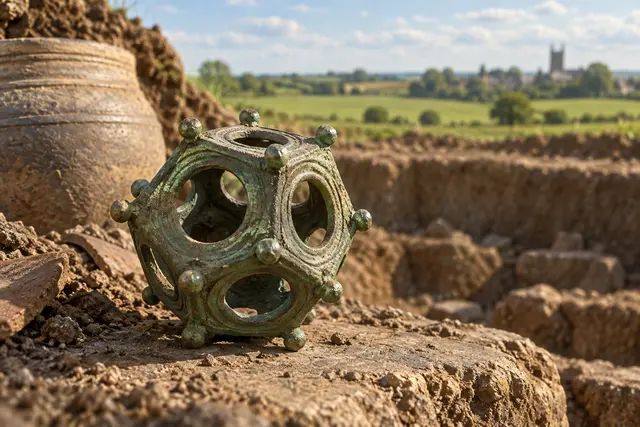
In June 2023, a group dig at Norton Disney unearths a remarkably preserved Roman object. Hollow and made of a copper alloy, it has twelve faces. Its manufacture can be studied with precision, but a very simple question resists: what was it exactly for?
The community that presented the object recalls that several hypotheses exist, from a measuring instrument to ritual use. In this case, the context provides an additional clue: the dodecahedron was found in a pit with pottery from the 4th century. This documents its archaeological environment without automatically providing instructions for use.
An ingenious idea is not yet a demonstration. An object can sometimes perform several gestures imagined today without having been made for them. The mystery does not lie in an impossible technology: materials and form are accessible for study. What is missing is the assured link between this form and a precise ancient practice.
What we know
The proposed functions remain hypotheses.
To go to the source
References consulted on 3 October 2026. Linked pages may be in another language.
Signaler une erreur ou apporter une précision