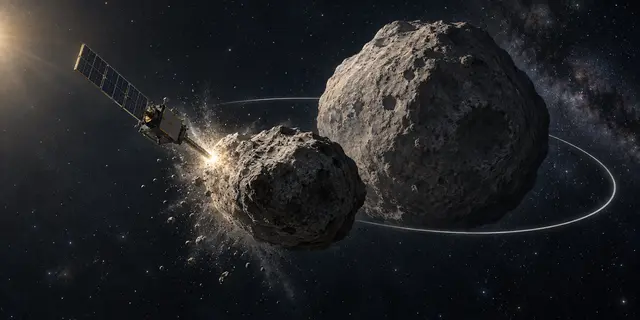
On September 26, 2022, a probe rushes towards a small asteroid without trying to avoid it. Its disappearance is planned: DART must test what an impact can change to the movement of a celestial body. The target, Dimorphos, revolves around a larger asteroid, Didymos. Astronomers already know the length of this journey.
After the shock, they monitor the light variations of the couple. When one body passes in front of the other or gives it shade, the observed brightness decreases. The rhythm of these events makes it possible to recover the orbital period. An analysis presented in 2024 establishes a shortening of about thirty-three minutes, with an orbit that has become slightly elongated.
The models also indicate a change in the form of Dimorphos. So the experiment wasn’t just about leaving a mark on a rock. A craft made on Earth has changed a measurable movement in space. The result informs a deflection technique; it does not guarantee that an identical impact would be suitable for all asteroids.
What we know
The time measured is the orbit around Didymos.
To go to the source
References consulted on 3 October 2026. Linked pages may be in another language.
Signaler une erreur ou apporter une précision