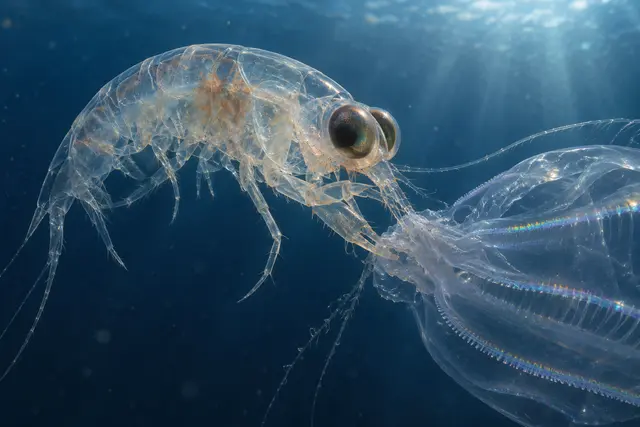
Cystisoma swims in open water, with few places to hide. Its almost transparent body reduces its visibility, but its eyes are imposing: they can occupy up to a third of its length. You have to see your own prey without becoming a figure too easy to spot.
Researchers at MBARI and their collaborators studied its surface, where tiny structures and biological coatings limit reflections. The retinas are divided into a thin sheet of small dots, which reduces the shadow they produce.
Observations show this amphipod pulling matter from a ctenophore with its clamps. Transparency does not mean passive fragility or lack of predatory activity. It is a camouflage particularly suited to a place without walls or foliage: where there is a lack of a decor behind which to disappear, the body itself must become discreet.
What we know
Description of the genus Cystisoma; almost transparent, not absolute invisibility.
To go to the source
References consulted on 3 October 2026. Linked pages may be in another language.
Signaler une erreur ou apporter une précision