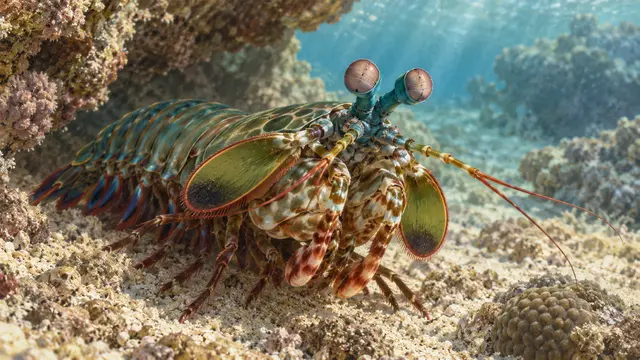
The eyes of a mantis shrimp already seem out of the ordinary: perched on peduncles, they can move independently. Inside, their equipment is just as amazing. Depending on the species, there are many types of photoreceptors, sometimes up to sixteen.
These crustaceans can detect ultraviolet rays and polarization properties of light. Polarization describes the orientation of light oscillations; it is not simply an additional color added to a box of pencils. Their visual system collects information that is different from that which dominates our usual experience.
The figure makes us dream of unimaginable colors. However, it is not enough to reconstruct what the animal experiences. The real astonishment is already considerable: the same light medium can provide two species with different information. Seeing otherwise doesn’t just mean looking at our world with a larger palette.
What we know
Receptor grouping and polarization. The mantis shrimp is distinct from the gun shrimp; the striking and slamming mechanisms are not interchangeable.
To go to the source
References consulted on September 21, 2026. Linked pages may be in another language.
Signaler une erreur ou apporter une précision