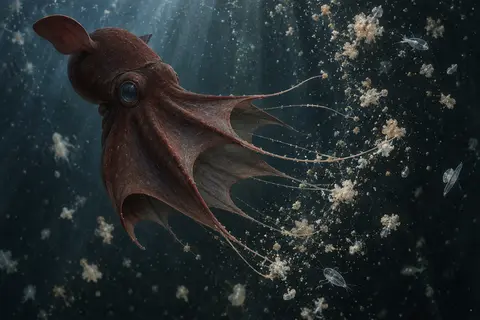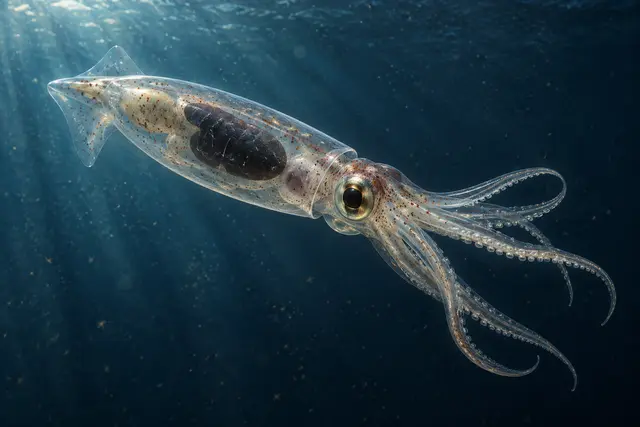
Glass squid, or cranchiids, often have almost transparent skin. In the open water, where hiding places are lacking, this discretion limits their silhouette. However, it does not mean that they lack the pigment cells characteristic of cephalopods.
Their chromatophores can spread and darken the animal. For some, the ink is even released into a cavity of their own body rather than immediately around them. Researchers interpret this coloring as a possible way to blend into the darkness.
If the threat persists, the ink can also be expelled into the water to create a diversion. The contrast is unexpected: an animal that usually protects itself by becoming difficult to see can adopt another appearance, very dark. Transparency and ink are therefore not two strategies reserved for separate worlds.
What we know
Behaviours specific to certain species; function of internal filling formulated as interpretation.
To go to the source
References consulted on 3 October 2026. Linked pages may be in another language.
Signaler une erreur ou apporter une précision