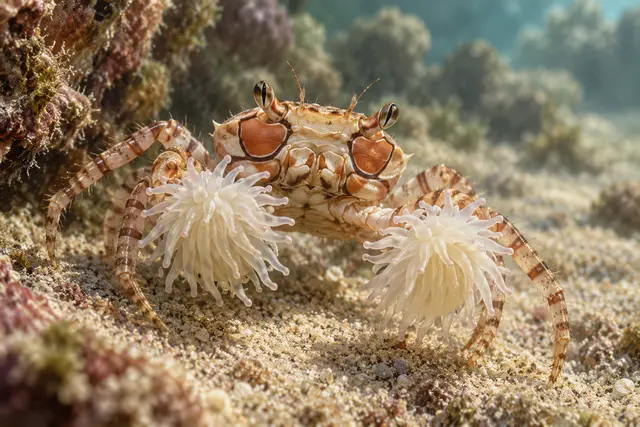
The little crab Lybia leptochelis carries an anemone in each of its claws. These two partners remain alive. One team wanted to understand how the crab acquires this particular pair. In particular, she removed one anemone from individuals observed in the laboratory, leaving the other in place.
The crabs then divided their remaining anemone into two fragments. After regeneration, each part could form a complete anemone, giving the animal a partner in each clamp. In other experimental encounters, crabs deprived of anemones have taken one, or a fragment, from a congener. The sharing could then resume from this acquisition.
Genetic analyses on animals collected from the wild also found genetically identical pairs of anemones. This is consistent with their clonal origin, without measuring the frequency of each behavior in the natural environment. Here, one animal can cause the asexual multiplication of another: the singularity of the duo far exceeds the look of tiny boxing gloves.
What we know
The manipulations were observed in the laboratory.
To go to the source
- PeerJ — Présentation de Schnytzer et collègues, 2017 (new tab)↗
- Schnytzer et collègues — PeerJ, article archivé dans PMC (new tab)↗
References consulted on September 21, 2026. Linked pages may be in another language.
Signaler une erreur ou apporter une précision