Damaged plates during washing can seem like a small domestic problem. For Josephine Cochran, they become the starting point of a mechanical project. Instead of asking for more precautions, she is looking at how a machine could clean the dishes while keeping it properly in place.
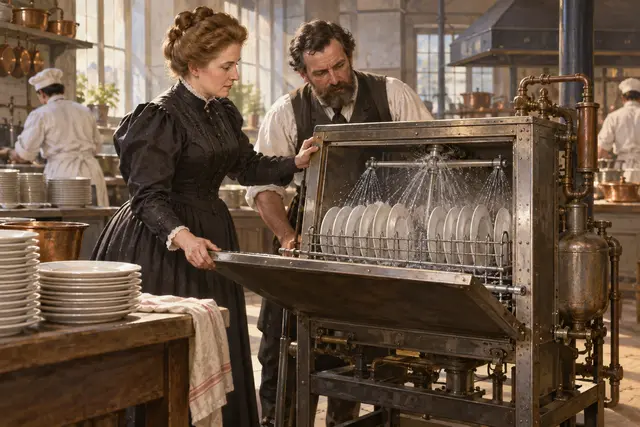
Its system combines supports adapted to the parts and water under pressure. It does not rest on elements directly rubbing the surfaces. With the help of mechanic George Butters to realize his prototype, Cochran obtained an American patent in 1886. Other washing machines had existed before; his contribution does not begin in a desert of inventions.
It remains to convince buyers. Restaurants and hotels are an essential outlet, then the Chicago exhibition of 1893 gives a new visibility to his machine. The detour is revealing: an invention born from a house concern first finds an important place in kitchens where dishes are counted in large quantities.
What we know
Cochran perfects an already existing family of machines; domestic success is not immediate.
To go to the source
References consulted on September 21, 2026. Linked pages may be in another language.
Signaler une erreur ou apporter une précision