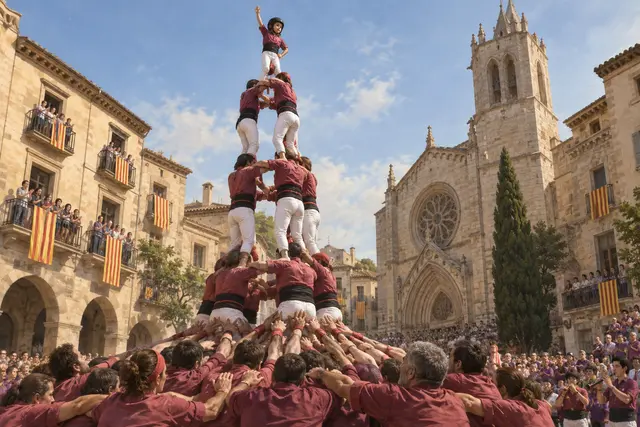
A small figure rises above a compact group. In Catalan castells, participants build a tower by leaning on each other’s shoulders. The child at the top raises his hand. You might think the demonstration is over.
The Castells Museum of Catalonia reminds us of the other half of the challenge: we must also undo the tower in order, without collapse. At its core, the pinya brings together many participants who support the whole. Above, the roles are distributed according to the organization of the structure; each one depends on the others well before being visible at the top.
The colors of the shirts identify the groups, while the music accompanies the construction. What the public perceives as an ascent is therefore a collective exercise learned through practice. The highest person attracts attention, but he can accomplish nothing on his own. And the truly decisive moment comes after his salvation, when everyone must return to the ground.
What we know
Organized and learned practice; description without invitation to improvise.
To go to the source
References consulted on September 21, 2026. Linked pages may be in another language.
Signaler une erreur ou apporter une précision