How to reach an invisible island from the shore without following a map? In some Carolinian communities, especially on the outer islands of Yap, traditional navigation is based on learning the clues of the environment. Indices of the environment, particularly atmospheric phenomena, make up knowledge transmitted by experienced navigators to their students.
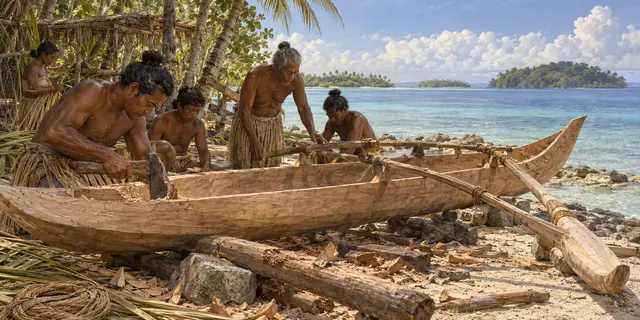
The journey begins on land. The construction of the canoe mobilizes the community, from the choice of the tree to the work of local materials. A system of proportions provides precise measurements; the herminette shapes the elements. The asymmetry of the craft responds to fast navigation and access to shallow waters, rather than a search for symmetry.
This heritage joined UNESCO’s Urgent Safeguarding List in 2021. Population displacements and competing transports complicate its transmission. Navigating in this way is not a mysterious instinct: you have to learn, memorize and practice. The traditions described belong to specific communities, within a Pacific with multiple maritime histories.
What we know
Learned navigation, with no supposed innate aptitude.
To go to the source
References consulted on 3 October 2026. Linked pages may be in another language.
Signaler une erreur ou apporter une précision