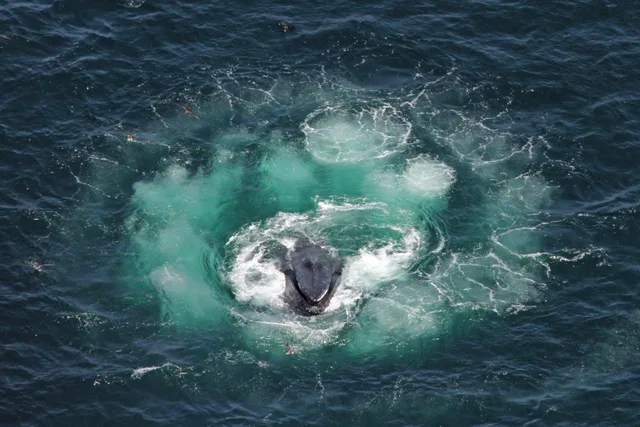
A net appears in the water, but no boat has put it down. A humpback whale produces bubbles around a concentration of krill, and then crosses the area for food. The barrier is made of air and water: it has no solid meshes or ropes to raise.
A study presented in 2024 followed this hunt in whales from southeastern Alaska. Not all of the observed animals breathed an identical circle. They could adjust the number of networks, their size, their depth and the spacing of the bubbles. The researchers linked this manipulation to increased prey capture without an equivalent increase in energy expenditure.
These observations concern whales hunting alone and situations studied, not every meal of the species. They nevertheless give a new dimension to the scene: the large animal does not just open its mouth in a cloud of small prey. He first modifies this cloud with the help of a structure that he makes himself.
What we know
Study of solitary hunts; gain not generalizable at all meals.
To go to the source
References accessed October 11, 2026. Linked pages may be in another language.
Signaler une erreur ou apporter une précision