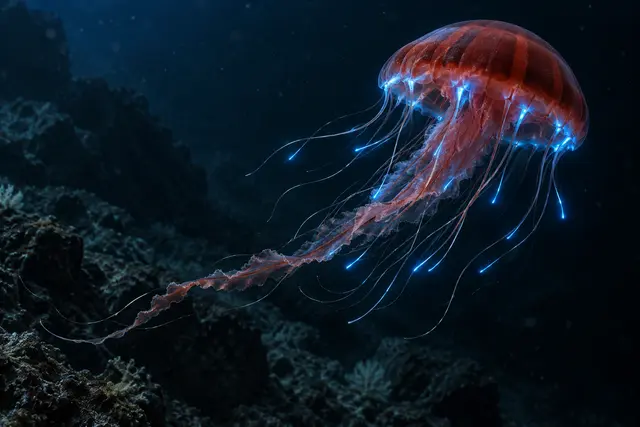
In the darkness of the depths, the red of Atolla’s parasol looks dark. This camouflage changes abruptly when it produces blue bursts of bioluminescence. A discreet jellyfish then becomes a particularly visible point of light.
This reaction is interpreted as a defense that can disorient the attacker and attract the attention of larger predators. The image of an “anti-theft alarm” helps to understand the idea, but does not mean that each emission necessarily leads to the arrival of a rescuer.
Many Atolla also carry a long, trailing tentacle, probably useful for capturing prey. However, researchers have discovered related forms that lack them, including Atolla reynoldsi. The familiar jellyfish of underwater films does not exhaust the diversity of the group: even its most characteristic appendix is not found everywhere.
What we know
Defensive effect interpreted; no guarantee of arrival of a third-party predator.
To go to the source
References consulted on 3 October 2026. Linked pages may be in another language.
Signaler une erreur ou apporter une précision