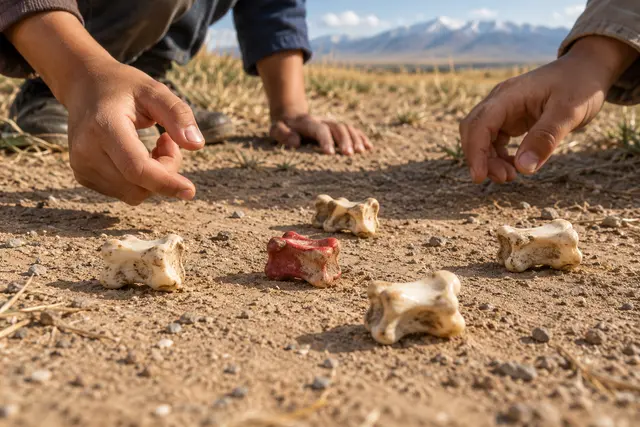
A sheep’s bone may seem like a curious object to keep in a pocket. In Kazakhstan’s traditional assyk games, however, it becomes a coin that the player seeks to launch accurately. The material usually comes from the astragalus, a bone located in the region of the animal’s ankle.
Each participant has his set, with a saka painted in a bright color. The principle described by UNESCO is to move the opposing assyks out of the playing area; the position of the bone counts in the game. Its irregular shape thus gives a role to the orientation, the look and the gesture of the player.
The activity is practiced especially in the open air and during festive gatherings. The younger ones learn by observing the larger ones, while associations maintain this transmission. These objects are not only kept as souvenirs: they continue to be used to organize meetings and to recognize a game learned in childhood.
What we know
General description; rule variants are not confused with a single rule.
To go to the source
References consulted on 3 October 2026. Linked pages may be in another language.
Signaler une erreur ou apporter une précision