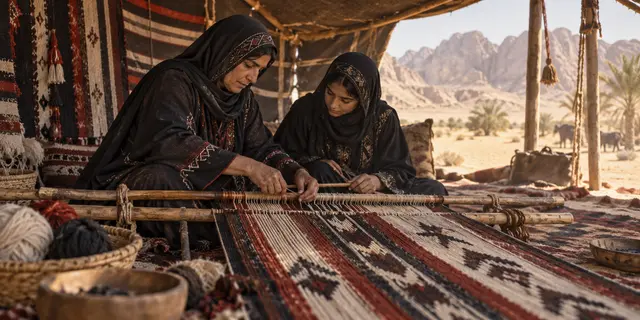
To make a fabric, there is no need for an imposing vertical machine. The Al Sadu weaving described by UNESCO is practiced on the ground. Bedouin women work with natural fibers to obtain a dense and resistant fabric.
Geometric patterns, repetitions and colors make up a visual language related to their environment. The fineness of the thread and the know-how of the weaver determine the sharpness of the drawing. The finished object reveals only part of the work: behind each motif are gestures that had to be learned.
This textile has also acquired a value of cultural symbol, beyond its material uses. Experienced weavers pass on their knowledge; associations and workshops participate in this effort. What seems immobile, once the fabric is finished, depends in reality on a continuous movement: that of a knowledge that passes from one person to another.
What we know
The file cited concerns Kuwait, Saudi Arabia and Qatar. There is also a separate case for the United Arab Emirates.
To go to the source
References consulted on September 20, 2026. Linked pages may be in another language.
Signaler une erreur ou apporter une précision