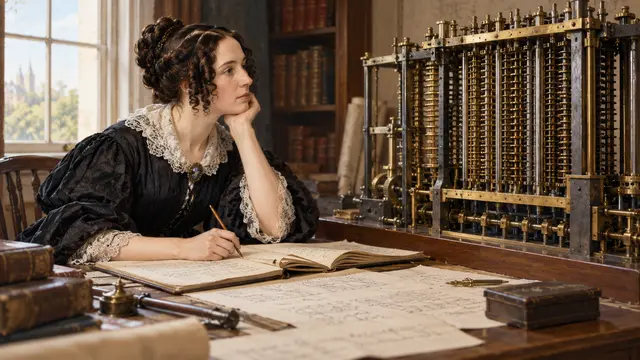
In the 19th century, Charles Babbage’s analytical machine was an ambitious mechanical project. In studying what she could accomplish, Ada Lovelace doesn’t stop at the idea of a more powerful calculator.
In its notes, it envisages that elements other than quantities can be represented and manipulated according to rules. The music is part of this reflection: if the relationships between the sounds could be expressed in an appropriate way, a machine could work on them.
This is not a concert produced by a Victorian computer. The envisaged machine did not carry out this promise before his eyes. The fascinating detail is precisely here: long before sound files and screens, Lovelace looks at a mechanical project and sees possibilities that no longer look like simple additions.
What we know
It is a theoretical anticipation, not a music actually generated by the machine in its time.
To go to the source
References consulted on September 20, 2026. Linked pages may be in another language.
Signaler une erreur ou apporter une précision