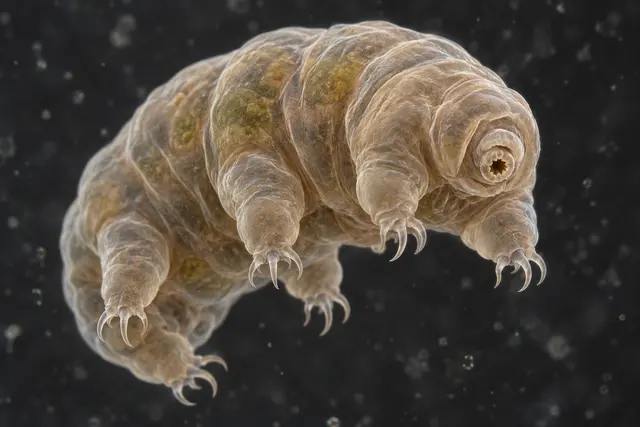
They are tiny, usually live in wetlands and have nothing to do with interplanetary travelers. However, in September 2007, tardigrades embarked with the Foton-M3 mission. The TARDIS experiment studies their resistance to exposure to the space environment.
The results show that some can survive the vacuum. Their ability to withstand desiccation is at the heart of the questions posed by the researchers: how do their cells remain sufficiently preserved to allow recovery after these extreme conditions?
Performance has limits. A short experimental exposure does not demonstrate that an animal can live, feed and reproduce indefinitely in space. Nor does it prove an extraterrestrial origin of terrestrial life. The result remains extraordinary without these extrapolations: an animal on our planet has mechanisms capable of making it go through a test that seemed out of its world.
What we know
Mission of 2007, results presented in 2008; survival of some specimens under experimental conditions, not invulnerability.
To go to the source
References consulted on September 21, 2026. Linked pages may be in another language.
Signaler une erreur ou apporter une précision