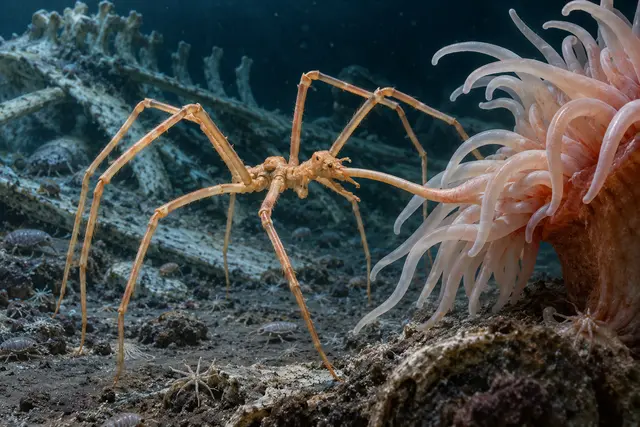
On the bottom of the great depths, the long articulated legs of Colossendeis evoke an outsized spider. The animal belongs to the pycnogonides, often called sea spiders. His way of eating does not resemble that of a spider waiting in a web.
An elongated tube is used to take his food. The MBARI researchers observed an individual clinging to the fleshy tentacle of an anemone, whose contents he sucked up. Another observation shows a pycnogonide detaching tentacles to take them away.
These behaviors were filmed around communities associated with whale carcasses. They describe real scenes of predation, without turning each animal in the group into a specialist of this prey alone. Under this familiar figure hides a different equipment: large legs to travel the bottom, then a trunk to take the meal.
What we know
Pycnogonid, different from terrestrial spiders; particular observations on anemones.
To go to the source
References consulted on 3 October 2026. Linked pages may be in another language.
Signaler une erreur ou apporter une précision