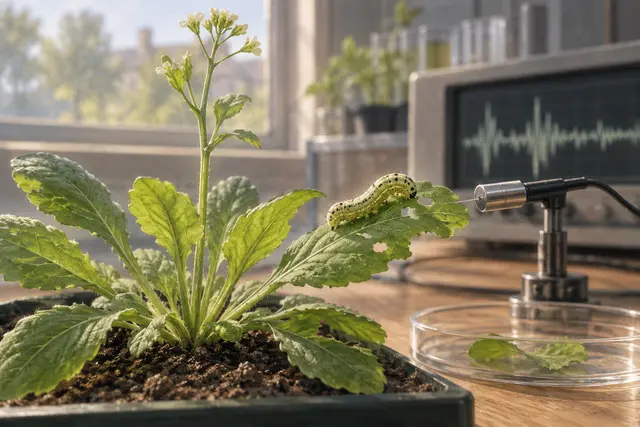
A caterpillar chews a leaf and makes it vibrate. The movement is tiny, but it can carry information. To test it, researchers at the University of Missouri recorded these vibrations, then reproduced them on plants without first devouring them.
The experiment, presented in 2014, focused on Arabidopsis thaliana. After exposure to chewing vibrations, the plants showed an increased chemical defense response when they were subsequently attacked. Other vibrations tested, especially those associated with the wind, did not give the same result.
The surprise comes from the method as much as from the plant: by replaying a mechanical signal, the researchers were able to distinguish its effect from that of injuries. Talking about a plant that listens is an image. She doesn’t need ears or conscious intention for her body to react to what’s happening on a leaf.
What we know
Measured response in Arabidopsis in a specific protocol; neither human hearing nor consciousness attributed to plants.
To go to the source
References consulted on September 21, 2026. Linked pages may be in another language.
Signaler une erreur ou apporter une précision