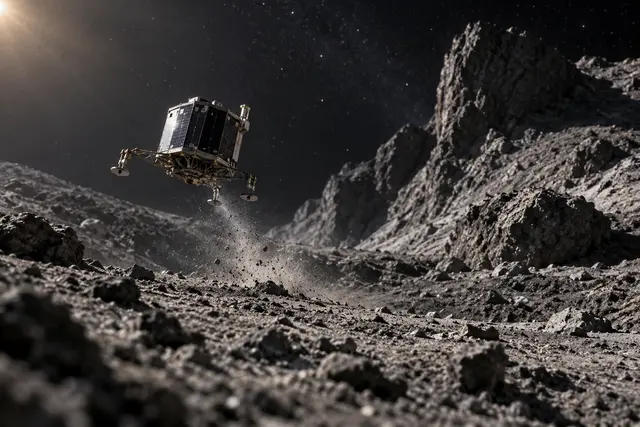
On November 12, 2014, Philae descended to comet 67P/Churyumov-Gerasimenko. The small lander reaches the ground, but does not stay there. It bounces and continues its movement above the surface. An expected arrival then becomes a new enigma: where will it end?
To reconstruct this journey, scientists are bringing together several types of measurements. Rosetta images, Philae magnetic data, radio information and gravity models each bring a part of the journey. The reconstruction presented by ESA in 2015 includes an encounter with a relief, then another rebound before immobilization.
Not all positions have the same precision: the first point of contact is well located, while some passages depend on the model used. Even the account of this arrival therefore requires an investigation. Philae did not just land at the end of a long descent; he forced his observers to find the stages of a landing that continued.
What we know
Trajectory reconstructed with uncertainty; not all intermediate contacts are located directly.
To go to the source
References consulted on September 21, 2026. Linked pages may be in another language.
Signaler une erreur ou apporter une précision