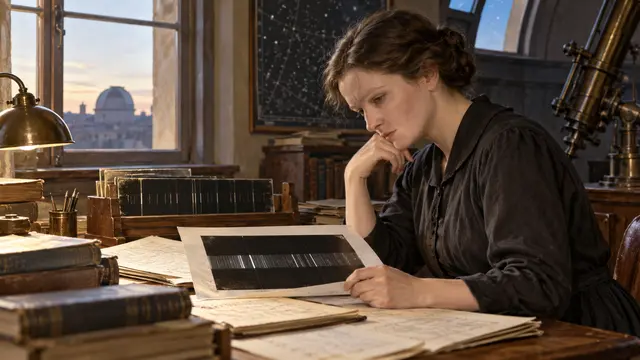
What are the stars made of? By studying their spectra, Cecilia Payne meets a result that shakes up the expectations of her time. Hydrogen and helium seem much more abundant than previously thought. So stars are not just scorching versions of familiar earth materials.
His thesis, published in 1925, contains a spectacular reserve: it probably considers unreal the enormous abundance calculated for these elements. The presentation of the Wolbach Library retraces the resistances encountered, in particular with the astronomer Henry Norris Russell. Numbers are well represented in the work; their interpretation is not yet fully accepted.
Four years later, Russell published conclusions confirming this abundance. The striking detail is not a hidden observation then found: the results were already there, in a thesis. This story shows how difficult it can be to take an answer seriously when it forces you to change your image of the sky.
What we know
The results were published in 1925; avoid recounting a completely censored discovery.
To go to the source
References consulted on September 21, 2026. Linked pages may be in another language.
Signaler une erreur ou apporter une précision