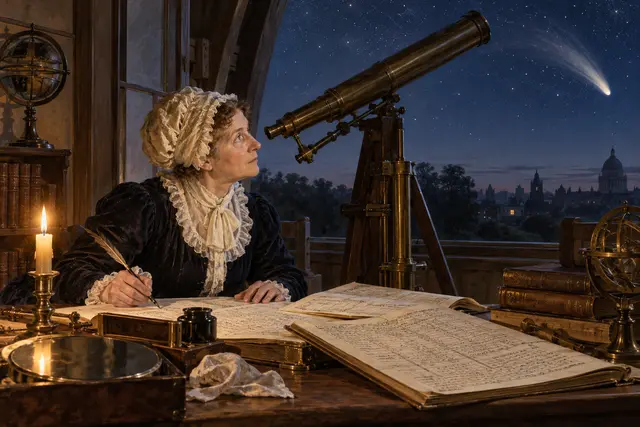
Caroline Herschel doesn’t just accompany her brother William’s work. She polishes mirrors, performs calculations and observes the sky herself with a telescope prepared for her. In 1786, she discovered a comet. Its activity becomes difficult to reduce to the simple role of a family caregiver.
The following year, George III gave him fifty pounds as William's assistant. According to the Royal Museums Greenwich, she became the first woman in Britain to be paid to pursue scientific work. This recognition does not erase the framework in which she works, but it gives her an unusual professional place.
Comets are only part of its contribution. Caroline also takes over John Flamsteed’s star catalog, checks the data and prepares corrections and an additional index. This patient work resulted in a publication in 1798. Behind the spectacular image of the discoverer is therefore another contribution: to make the sky already observed easier to study.
What we know
The wage priority cited concerns Great Britain; not to extend it to all companies.
To go to the source
References consulted on September 21, 2026. Linked pages may be in another language.
Signaler une erreur ou apporter une précision