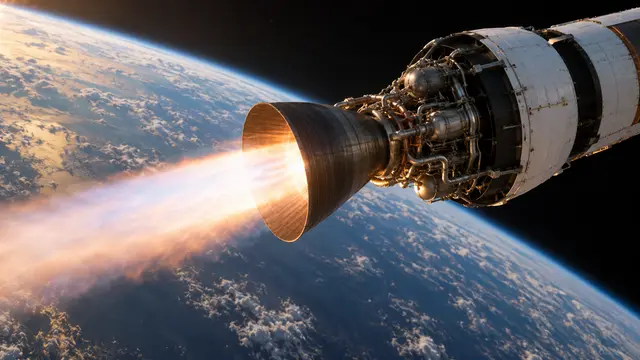
Space does not provide the air on which the combustion of an ordinary fire depends. However, a rocket engine can work there. The contradiction disappears when we look at what the vehicle carries: not only a fuel, but also its oxidizer.
The NASA guide explains that these substances react in a combustion chamber. The gases produced are expelled and create the thrust. An airplane jet engine uses oxygen from the ambient air; the rocket does not have this dependency because the oxidizer is carried on board.
Nor does it need to push against the outside air as against a wall. Expulsion of gases is sufficient for the principle of propulsion. The plume visible on take-off therefore gives an incomplete image: the machine is precisely designed to continue to act where part of our terrestrial intuition, based on the atmosphere, no longer applies.
What we know
The case of chemical rocket engines; without oxygen the air does not mean without oxidizer, and not all space propulsions rely on combustion.
To go to the source
References consulted on September 21, 2026. Linked pages may be in another language.
Signaler une erreur ou apporter une précision