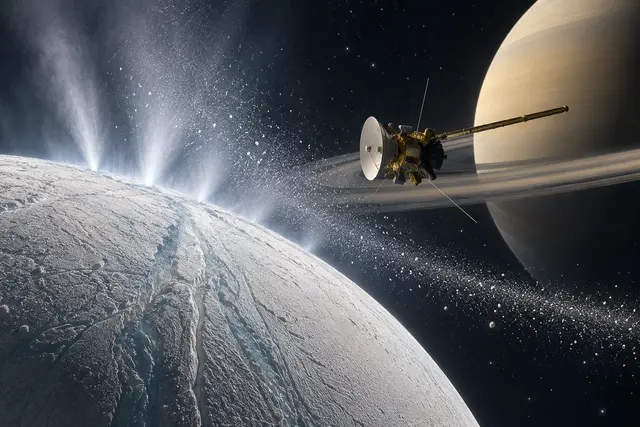
Enceladus seems to be a small icy world lost around Saturn. Yet, jets escape from fractures near its south pole. They project steam and ice particles into space. Cassini was able to encounter this material without having to land or pierce the crust.
Observations of plumes, combined with measurements of gravity and oscillations of the moon, indicate an ocean beneath the ice. Grains and gases give information about its chemistry. Some of the ejected particles even contribute to feeding Saturn’s E ring.
This does not mean that Cassini has found living beings. Liquid water and interesting ingredients for life are signs of habitability, not proof of biological presence. The amazing shortcut is elsewhere: an ocean inaccessible to view sends samples far above its ceiling. To learn more about the depths, the probe could stay in space.
What we know
Favorable ocean and chemistry do not mean detection of life.
To go to the source
References consulted on September 21, 2026. Linked pages may be in another language.
Signaler une erreur ou apporter une précision