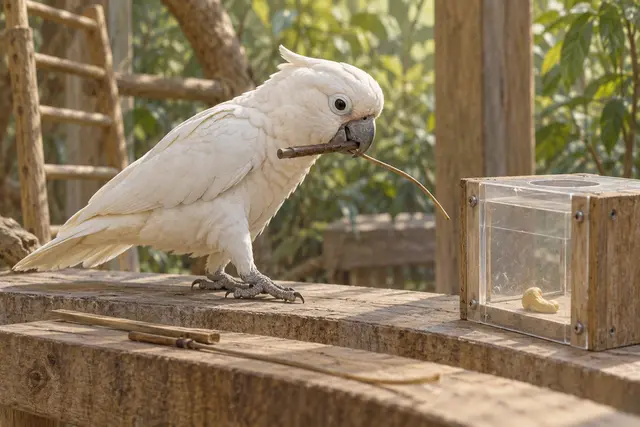
To reach a cashew in a box, Goffin’s cockatoos from an experiment sometimes had to use two successive tools. A rigid element pierced a membrane; a longer and flexible tool was then used to recover the reward. Without a membrane, the first tool became useless. Researchers could vary the needs.
Some birds have adapted their choice to the box presented. The team then complicated the transport: the tools were at a distance from the task, accessible by a ladder or a short flight. Several cockatoos took the two objects together when their successive use was necessary, instead of systematically multiplying the journeys.
This behavior suggests a flexible understanding of the tool set, beyond a simple gesture learned in isolation. It does not show that all cockatoos would do the same, nor that they reason exactly like humans. The interest lies in the differences observed: some individuals prepared suitable equipment before encountering the obstacle to be solved on the platform.
What we know
Behavior observed in some individuals in captivity.
To go to the source
References consulted on September 21, 2026. Linked pages may be in another language.
Signaler une erreur ou apporter une précision