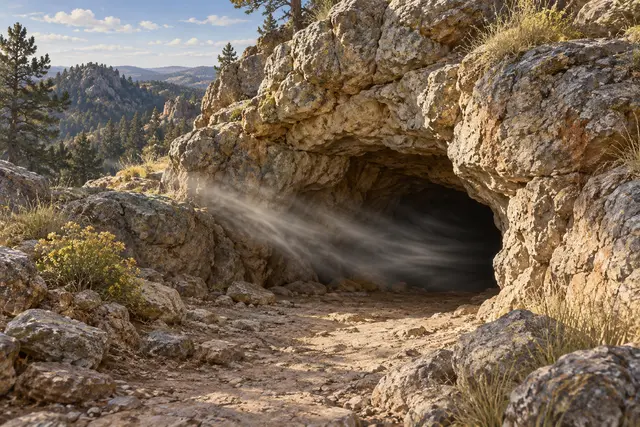
In front of the natural entrance of Wind Cave, South Dakota, the air can come out forcefully or enter the ground. The direction is not fixed once and for all. The name of the cave recalls this current, the cause of which lies in the difference in pressure between the inside and the outside.
When the external pressure exceeds that of the cavity, the air tends to enter it. When the situation reverses, it comes out. The huge underground network communicates with the atmosphere through few natural openings, which makes some of these exchanges particularly noticeable at the narrow passage of the entrance.
This movement is sometimes described as breathing. The comparison helps to imagine it, but does not involve lungs or living organisms. Measuring exchanges can even inform about the volume of underground spaces. A breath seen on the surface then becomes a clue to what remains hidden: not the exact length of each gallery, but the space available for the air under the feet.
What we know
An estimated volume of air does not give a certain map or weather forecast.
To go to the source
References consulted on 3 October 2026. Linked pages may be in another language.
Signaler une erreur ou apporter une précision