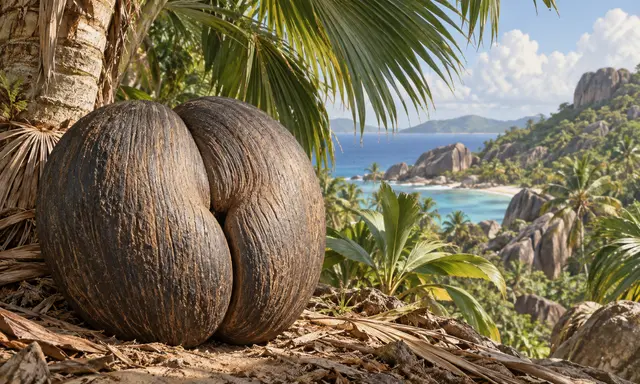
The seed of the coco de mer, Lodoicea maldivica, requires a change of scale. This Seychelles palm tree produces seeds among the most imposing curiosities of the plant world. However, their size is not explained by a simple tendency of nature to make ever bigger.
Researchers at Kew have compared this palm tree to its close relatives. Their study brings together genetic data, dimensions and ecology to reconstruct a succession of favorable conditions. A plant capable of supporting large seeds, useful reserves for the young plant and the possibilities of dispersal are all part of the proposed explanation.
On the islands, the absence of large dispersing animals would have favored a small number of even larger seeds. This evolutionary scenario has no intention for the palm tree. It shows how a spectacular singularity can result from accumulated constraints. The giant seed is not only an amazing object: it bears the trace of an island history that researchers are trying to reconstruct.
What we know
An evolutionary interpretation based on comparisons; no purported medicinal properties are retained.
To go to the source
References consulted on September 21, 2026. Linked pages may be in another language.
Signaler une erreur ou apporter une précision